RESEARCH
Original research on how people actually buy.
A working portfolio of consumer behavior research: published, in-progress, and in development. Some of it becomes books. Some becomes papers. All of it shapes how the brands I work with go to market.
THE THESIS
Life stage predicts consumer behavior. Generation does not.
Across every study I've designed, replicated, or contributed to, the same finding holds — a customer's current life situation predicts their buying behavior more reliably than the year they were born.
First-time homebuyers behave like other first-time homebuyers. New parents behave like other new parents. Recent retirees behave like other recent retirees. The variance within any of those life-stage clusters is dramatically lower than the variance within any birth-year cohort.
This is the foundation of every research project below. The studies test, replicate, extend, and apply the thesis across new categories, new audiences, and new behavioral variables. The book made the case. The ongoing research is what proves it at scale.
The work that's already in the world.
PUBLISHED
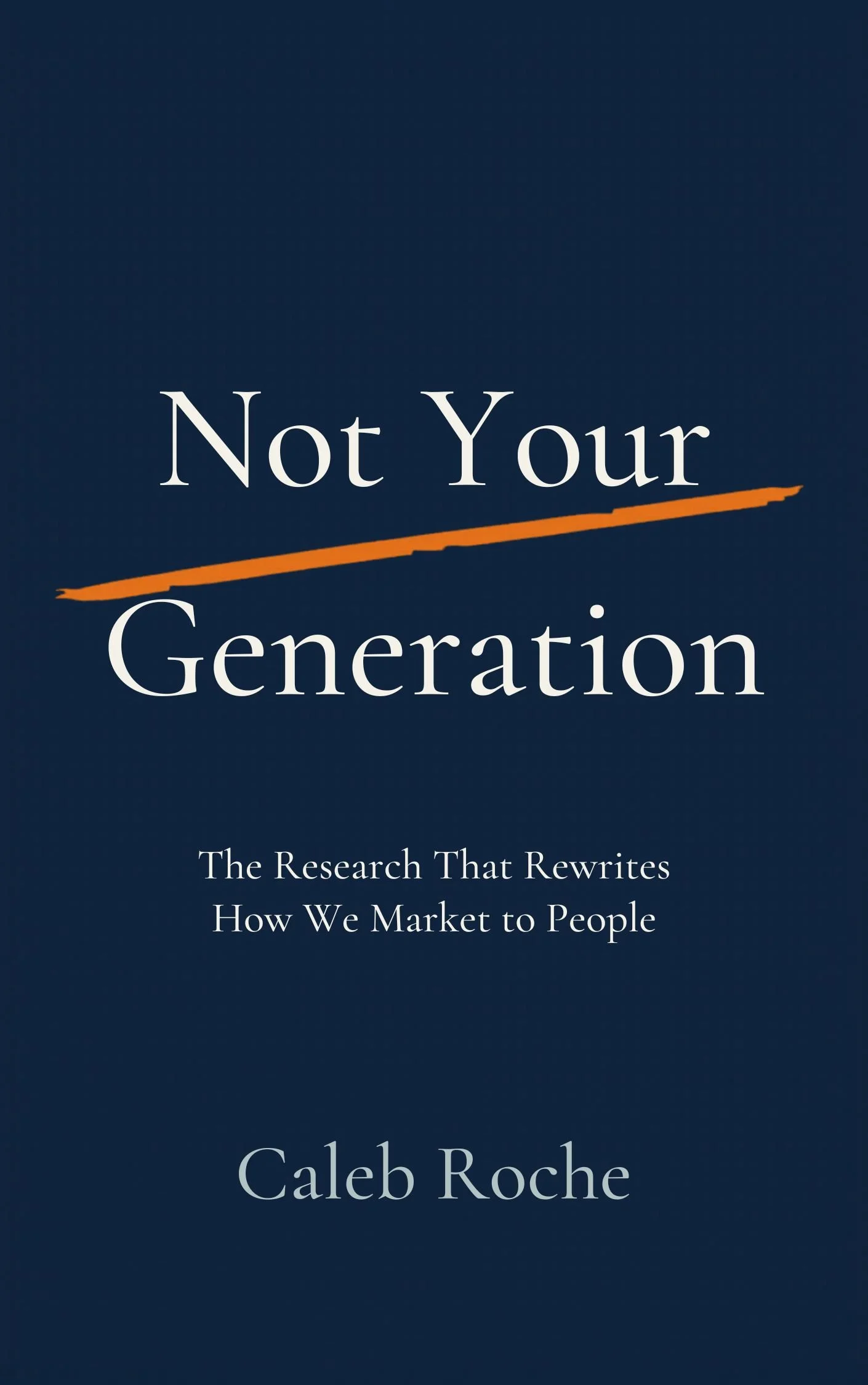
Not Your Generation
Book · 2026 · ~270 pages · 8 chapters
A research-backed argument for replacing generational marketing with life-stage segmentation. Built on an original survey across all four major generational cohorts using validated scales from the consumer behavior literature (Dodds, Monroe, & Grewal 1991; Yoo & Donthu 2001; Ducoffe 1996). Key findings include 66% of consumers saying life situation impacts buying more than generation, 79% trusting life-stage peers over age peers, and a 2.05/5 trust score for celebrity influencers compared to 4.51/5 for friends and family.
The Life-Stage Marketing Playbook
IN THE FIELD NOW
The follow-up book to Not Your Generation. Diagnosis becomes prescription.
Not Your Generation argued that life stage matters more than generation. This turns that thesis into a deployable playbook — seven distinct consumer life stages, each with its own messaging framework, its own measurable behavioral triggers, and its own validated brief.
THE SEVEN LIFE STAGES BEING STUDIED
• First-time homeowner
• New parent
• New city / recent relocation
• Career-changer
• Recent retiree
• Empty-nester
• Newly single or divorced
RESEARCH DESIGN
Two-study design. Study 1 is a broad segmentation survey of 400-600 qualified U.S. adults using cluster analysis to confirm the seven-stage framework empirically. Study 2 is a between-subjects vignette experiment that tests how each segment responds to messaging variants built specifically for their life stage.
CURRENT STATUS
Study 2 is currently in the field. Recruitment is running through Meta ads and direct social outreach, with respondents completing the survey through QuestionPro. The first round of findings will inform the manuscript for the book and a research paper for academic publication.
HOW THE RESEARCH WORKS
Methodology, briefly.
Every study I run is grounded in established consumer behavior research traditions. The instruments use validated scales. The sampling is structured for representativeness across age, gender, income, and life stage. The analysis follows accepted standards for quantitative consumer research.
In practical terms, that means three things.
• Validated instruments: Survey scales come from peer-reviewed sources, not improvised question sets. Examples include the Dodds, Monroe, and Grewal purchase intent scale (1991) and the Yoo and Donthu brand loyalty index (2001).
• Structured sampling: Respondents are recruited to balance across the demographic and life-stage variables that matter for the research question — not just whichever audience is cheapest to reach.
• Replicable analysis: Findings are documented with the underlying data, the statistical methods used, and the assumptions tested. Anyone with the time and tools should be able to verify the conclusions.
This rigor is the difference between consumer research that informs decisions and consumer research that confirms what someone wanted to hear. The brands I work with deserve the former.
How the research shapes the work.
RESEARCH IN PRACTICE
The research is not academic in the dismissive sense of the word. It informs how Club Creative builds segmentation for clients, how I structure marketing strategy for fractional CMO engagements, and how I teach consumer behavior at Oklahoma Baptist University.
A few practical examples.
APPLICATION 01
Client segmentation strategy
Club Creative clients are increasingly choosing life-stage targeting parameters over demographic targeting. The shift is driven by the original research findings on which segmentation variables actually predict behavior. The results show up in lower cost-per-acquisition and higher conversion rates compared to the demographic-only campaigns that preceded them.
APPLICATION 02
Fractional CMO frameworks
The fractional CMO engagements I run start with a segmentation audit. The audit framework is built from the research methodology — pressure-testing whether the client's current segmentation predicts behavior, or just describes demographics. Most companies need to rebuild segmentation entirely. The research is what makes that diagnosis possible.
APPLICATION 03
Classroom teaching at OBU
Students in my marketing courses see the actual research methods I use in client work and book writing. They learn to design surveys, evaluate research quality, and distinguish reliable findings from noise. This is the practitioner-led teaching the Pracademic positioning is built around.